
The right earthing circuit breaker should do more than simply trip when leakage occurs. For an electrical installation in India, you need to look at the residual-current sensitivity, current rating, protection type, breaking capacity, number of poles, test facility and compatibility with the connected load.
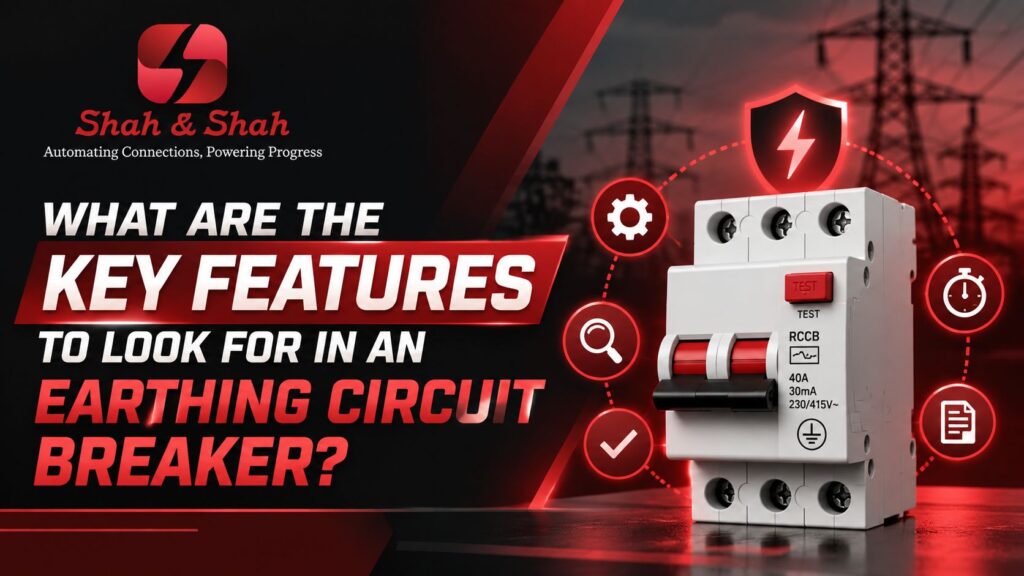
For homes, offices and commercial installations, a 30 mA residual-current device is commonly used for additional protection against electric shock. The CEA Safety Regulations 2023 specifically provide for residual-current protection in domestic installations with residual operating current not exceeding 30 mA.
But 30 mA is only one part of the selection. Here are the features worth checking before you buy or specify a device.
1. Check the residual-current sensitivity
The first number to check is the rated residual operating current, normally shown as IΔn.
It tells you how much leakage current the device can detect before it trips.
| Sensitivity | Typical application |
|---|---|
| 10 mA | Very sensitive applications where additional protection is required |
| 30 mA | Personal shock protection, domestic and final circuits |
| 100 mA | Selected commercial and industrial applications |
| 300 mA | Fire/leakage protection and upstream distribution applications |
A lower rating is not automatically better. Very sensitive protection can increase unwanted tripping when a circuit has several electronic loads or normal leakage currents.
Indian electrical guidance also warns that accumulated leakage from equipment such as switched-mode power supplies can cause unwanted tripping, making proper circuit division important.
2. Choose the correct RCD type
The type of residual-current protection matters, particularly in modern installations.
Traditional AC loads may be suitable for Type AC protection, while equipment containing electronic rectifiers, drives, inverters or other power electronics may require a different RCD type.
For example, variable-speed drives, certain air-conditioning systems, pumps and EV charging equipment can produce residual currents containing DC components or higher frequencies. The National Electrical Code of India identifies Type B applications where smooth DC residual current or higher-frequency residual currents can occur.
So don’t select the device only from the ampere rating. Look at the actual load.
3. Decide between RCCB and RCBO
This is one of the most useful checks for a distribution board.
An RCCB provides residual-current protection but normally needs a separate MCB for overload and short-circuit protection. An RCBO combines residual-current, overload and short-circuit protection in one device.
RCBOs are particularly useful where you want individual protection for separate circuits.
For example:
- Lighting circuit → individual RCBO
- Kitchen sockets → individual RCBO
- Outdoor socket circuit → individual RCBO
- Air-conditioner circuit → correctly rated RCBO
- Larger distribution board → RCCB plus separate overcurrent protection may be more suitable
The advantage of individual protection is fault isolation. If one circuit develops a leakage problem, the whole installation does not necessarily need to go off.
4. Check the rated current
The device’s current rating must match the circuit design.
Common ratings include 16 A, 20 A, 25 A, 32 A, 40 A, 63 A and higher values depending on the product range.
Do not select the breaker simply because its rating is equal to the appliance’s maximum current. The electrician or designer should consider:
- Connected load
- Cable size
- Installation method
- Ambient temperature
- Load diversity
- Starting current
- Existing upstream protection
The protective device must work with the cable and circuit, rather than being selected in isolation.
5. Look at breaking capacity
Breaking capacity becomes especially important in commercial and industrial panels.
It indicates the maximum prospective fault current that the device can safely interrupt under its specified conditions.
For a small residential circuit, the required value may be relatively modest. In an industrial installation close to a transformer or high-capacity supply, the available fault current can be considerably higher.
Before purchasing, check the manufacturer’s Icn/Icu/Ics specifications as applicable to the device and installation.
This is one area where a low-cost device with the correct ampere rating can still be the wrong choice.
6. Check the number of poles
Pole configuration should match the electrical system.
| Installation | Common configuration |
|---|---|
| Single-phase circuit | 1P+N or 2-pole device |
| Three-phase circuit | 3P+N or 4-pole device |
| Individual final circuit | Depends on supply and local design |
| Industrial distribution | Selected according to system arrangement |
The neutral conductor is important in residual-current protection. Incorrect neutral routing can cause nuisance tripping or prevent the protection system from operating as intended.
7. A test button is essential
A good residual-current device should provide a convenient test function.
The test button creates an artificial imbalance so that the operating mechanism can be checked without waiting for a real leakage fault.
If the device does not trip when tested according to the manufacturer’s instructions, it should not simply be reset and ignored.
Testing should form part of the electrical maintenance routine. Manufacturer instructions and the installation’s maintenance requirements should determine the actual testing interval.
8. Check for nuisance-tripping resistance
Modern buildings can contain dozens of electronic devices: computers, LED drivers, UPS systems, variable-speed drives, chargers and power supplies.
These loads can produce small normal leakage currents.
If several circuits are placed behind one sensitive device, those currents can add together and cause unnecessary trips.
A better design may involve:
- Dividing circuits across multiple RCDs
- Using individual RCBO protection
- Selecting the correct RCD type
- Coordinating upstream and downstream devices
- Checking actual leakage before final selection
The National Electrical Code specifically highlights proper sectionalising and discrimination as ways to reduce false tripping.
9. Check selectivity and coordination
A common mistake is installing multiple residual-current devices without checking how they interact.
Imagine a 30 mA device protecting a final circuit and a 300 mA device upstream. If the downstream device is correctly selected, a fault should normally be cleared by the device closest to the affected circuit rather than disconnecting the entire installation.
For larger installations, selective or time-delayed devices may be used where appropriate. The aim is simple: the smallest affected section should trip first.
This is particularly important in factories, offices, hospitals, commercial buildings and other installations where an unnecessary shutdown can interrupt important equipment.
10. Don’t treat the breaker as a replacement for earthing
This is an important point that is often missed.
Residual-current protection provides an additional safety layer. It does not mean the protective earth conductor can be removed or ignored.
Indian electrical requirements continue to emphasise effective earthing, equipotential bonding, low enough earth-fault loop impedance and continuity of the earthing system.
A good protection system therefore combines:
Proper earthing + suitable overcurrent protection + correctly selected residual-current protection.
A practical selection checklist
Before ordering a device, check these points:
| What to check | Why it matters |
|---|---|
| Residual sensitivity | Determines when leakage protection trips |
| RCD type | Must suit the type of load |
| Rated current | Must match circuit and cable design |
| Breaking capacity | Must withstand available fault current |
| Number of poles | Must match the supply arrangement |
| Overload protection | Determines whether RCCB or RCBO is suitable |
| Test button | Allows functional testing |
| Selectivity | Prevents unnecessary shutdown of healthy circuits |
| Standards/compliance | Confirms the device is suitable for the application |
| Manufacturer data | Provides verified electrical and operating limits |
What should you prioritise for an Indian installation?
For a typical residential installation, start with the required residual sensitivity and the circuit rating. For individual final circuits, an RCBO can provide a clean solution because leakage, overload and short-circuit protection are combined.
For commercial and industrial installations, selection needs more care. The fault level, connected equipment, distribution-board arrangement, leakage currents and coordination between protective devices should all be considered.
For electronic loads, drives and other equipment that can produce non-standard residual currents, selecting the correct RCD type becomes especially important.
Shah & Shah can help businesses and electrical contractors identify suitable protection equipment based on the application, load and panel requirements.
Final takeaway
The best protection device is not necessarily the one with the highest rating or the most features. It is the one that matches the electrical system.
For Indian installations, start with the required residual-current sensitivity, then check the load type, current rating, breaking capacity and pole configuration. Finally, make sure the device is coordinated with the rest of the distribution board and that the earthing system itself is properly designed and maintained.
For applications involving modern electronic equipment, Digital Type RCDs can also be considered where their monitoring and protection features match the requirements of the installation.
With the right selection, the protection device becomes part of a complete safety system rather than simply another component inside the panel.
Shah & Shah supplies electrical protection and distribution equipment for commercial and industrial applications across India.
Is 30 mA suitable for every application?
No. 30 mA is widely used for additional shock protection, particularly in domestic and final circuits, but larger distribution systems may require different residual-current ratings. The correct value depends on the protection objective and installation design.
Should I choose an RCCB or an RCBO?
Choose an RCCB when separate overcurrent protection is already provided or when that arrangement suits the distribution board. Choose an RCBO when individual circuits need combined residual-current and overcurrent protection.
Can residual-current protection replace proper earthing?
No. Earthing remains an essential part of the electrical safety system. Residual-current protection should supplement, not replace, protective earthing.
Why does an RCD keep tripping?
Frequent trips can be caused by genuine leakage, accumulated leakage from several electronic loads, incorrect wiring, insulation problems or an unsuitable device type/rating. The circuit should be checked by a qualified electrical professional rather than repeatedly resetting the device.
What should I check before buying one?
Check the residual-current sensitivity, current rating, device type, breaking capacity, number of poles, overload protection, applicable standards, test function and compatibility with the connected equipment.