Industrial automation requires more than basic machine control. Modern factories need fast response times, accurate positioning, reliable communication, and clear fault diagnostics. The Siemens SIMATIC S7-1500 PLC meets these demands with high processing performance, flexible hardware, and integrated engineering tools.
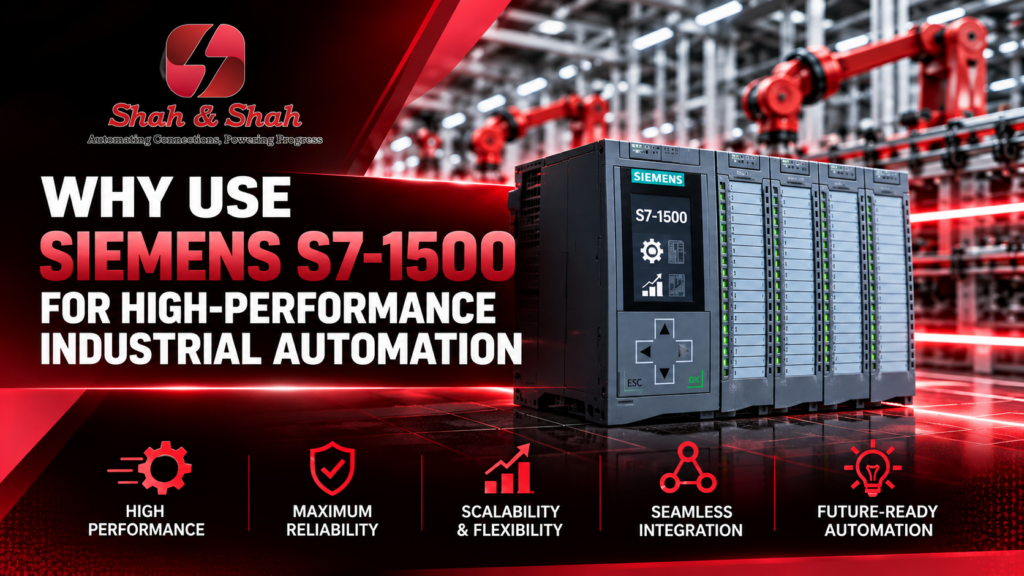
For Indian manufacturers handling complex production lines, packaging systems, material handling, or automated machinery, the S7-1500 offers a strong platform for improving machine performance and simplifying maintenance. Shah & Shah helps industrial buyers explore automation products suited to their project requirements.
What Is the Siemens S7-1500 PLC?
The Siemens SIMATIC S7-1500 is a programmable logic controller designed for medium- to high-performance industrial automation. It processes input signals, executes control logic, and sends commands to connected equipment such as motors, valves, sensors, and actuators.
Unlike a basic controller designed for straightforward machine operations, the S7-1500 supports demanding applications that require fast processing, extensive communication, motion control, and advanced diagnostics.
Its modular design allows engineers to select a suitable CPU, signal modules, communication modules, and other components according to the application.
7 Reasons to Use Siemens S7-1500 for Industrial Automation
1. Fast Processing for Demanding Applications
High-speed production equipment must respond quickly to sensor signals and changing operating conditions. The S7-1500 provides fast program execution and efficient signal processing to support these requirements.
For example, a packaging machine may need to detect products, control conveyor movement, and coordinate several operations within a short cycle. A suitable S7-1500 CPU can manage this logic with the response time the application requires.
However, actual performance depends on the selected CPU, program complexity, communication load, and connected hardware.
2. Integrated Motion Control
Many industrial machines require accurate movement rather than simple start-and-stop control. The S7-1500 family supports motion-control functions, while selected technology CPUs provide additional capabilities for demanding motion applications.
These functions can help engineers coordinate positioning, speed-controlled axes, and synchronised machine movements.
Common applications include:
- Automated packaging and filling machines
- Pick-and-place systems
- Conveyor synchronisation
- Assembly and handling equipment
- Special-purpose manufacturing machines
As a result, engineers can choose a suitable controller from the same product family without automatically moving to a separate motion-control platform.
3. Easier Engineering with TIA Portal
The Totally Integrated Automation Portal (TIA Portal) brings PLC programming, hardware configuration, and supported HMI engineering into a common environment.
Engineers can configure devices, develop control logic, monitor variables, and troubleshoot supported components within the same project workflow. This can reduce engineering effort and make changes easier to manage.
The S7-1500 plus TIA combination is particularly useful when a project needs coordinated PLC and HMI development, structured programming, and consistent maintenance documentation.
Nevertheless, teams should confirm software version compatibility, licensing, firmware requirements, and available engineering skills before selecting a system.
4. Better Fault Diagnosis and Maintenance
Unexpected stoppages can affect production targets, labour costs, and delivery schedules. The S7-1500 includes system diagnostics and supports diagnostic information that helps maintenance teams identify problems.
Its display-equipped CPU variants can also provide useful status information directly at the control panel. In addition, trace functions help engineers examine selected variables over time and investigate intermittent faults.
Consider a conveyor that stops occasionally during a production shift. Instead of relying only on visual inspection, an engineer can examine relevant signals, timing conditions, and diagnostic messages to narrow down the cause.
This approach does not eliminate downtime, but it can help teams resolve faults more systematically.
5. Flexible Expansion and Integration
Production requirements change as factories add machines, sensors, drives, or new process stages. The S7-1500’s modular architecture lets engineers design a controller around the current application and expand it where supported.
Depending on the configuration, the system can incorporate:
- Digital and analogue input/output modules
- Distributed I/O systems
- PROFINET-connected devices
- Additional communication modules
- Compatible HMI and SCADA systems
- Supported technology and safety functions
Therefore, the controller can suit both individual machines and more extensive automation systems. Engineers should still calculate I/O capacity, network requirements, memory needs, and future expansion before finalising the hardware.
6. Industrial Communication and Connectivity
Modern factories rely on communication between controllers, drives, operator panels, supervisory systems, and other devices. Many S7-1500 CPUs include PROFINET interfaces, while compatible configurations support additional communication options.
OPC UA capabilities can also support data exchange with suitable higher-level systems. This can help manufacturers collect production information, connect equipment, and develop more informed monitoring processes.
For Indian factories planning digital upgrades, connectivity matters because new equipment often needs to work alongside existing machines. Before purchasing, confirm that the required protocols, interfaces, data structures, and security features match the complete system design.
7. Options for Different Automation Requirements
The S7-1500 family includes different CPU performance levels and specialised variants. This lets engineers match controller capabilities to the application’s actual needs.
For example, a machine with extensive I/O, demanding control logic, and multiple communication tasks may require a different CPU from a compact machine with a modest program.
The range also includes specialised options for applications such as safety, motion control, and redundancy, subject to model-specific limitations.
Choosing the right variant is essential. A higher-specification CPU will not automatically improve production if the existing application does not need its additional capabilities.
Where Is the Siemens S7-1500 Used?
The controller can support a wide range of industrial applications when engineers select the correct CPU and associated hardware.
| Industry or application | Typical automation requirement |
|---|---|
| Automotive manufacturing | Assembly sequences, conveyors, and machine coordination |
| Pharmaceuticals | Equipment control, process monitoring, and traceable operating data |
| Food and beverage | Filling, packaging, and production-line coordination |
| Packaging machinery | Product handling, sequencing, and synchronised movement |
| Material handling | Conveyor control, sorting, and transfer systems |
| General manufacturing | Machine control, monitoring, and production data collection |
These are application examples, not a guarantee that every CPU supports every requirement. Safety, environmental conditions, process regulations, and system architecture must guide the final selection.
Siemens S7-1500 vs a Basic PLC: What Is the Difference?
| Selection factor | Basic PLC application | Siemens S7-1500 |
|---|---|---|
| Control complexity | Simple machine sequences | Medium- to high-complexity applications |
| Processing demands | Modest logic requirements | CPU options for demanding control tasks |
| Motion control | Depends on the controller and system | Integrated motion-control functions |
| Diagnostics | Depends on model | Advanced diagnostic and trace capabilities |
| Expansion | Depends on available I/O and interfaces | Modular expansion options |
| Engineering | Varies by platform | Integrated engineering through TIA Portal |
A basic PLC can remain the better choice for a small machine with straightforward logic and limited expansion needs. In contrast, the S7-1500 becomes attractive when control complexity, processing speed, diagnostics, or motion requirements justify the additional investment.
How to Select the Right S7-1500 CPU
Before purchasing, prepare a short technical checklist.
- Calculate I/O requirements: Include current signals and a realistic allowance for future additions.
- Review processing needs: Consider program size, cycle-time targets, communication load, and response requirements.
- Identify motion requirements: List the number and type of axes, positioning needs, and synchronisation functions.
- Check communication: Confirm the required PROFINET, HMI, SCADA, and other supported interfaces.
- Review safety requirements: Select compatible fail-safe hardware and engineering options where the risk assessment requires them.
- Check software compatibility: Verify the CPU firmware, TIA Portal version, licences, and available engineering support.
- Compare total project cost: Include the CPU, modules, software, panel changes, commissioning, training, and spare parts.
This checklist helps buyers avoid paying for unnecessary features or choosing a controller that cannot meet future production needs.
Why Buy Through Shah & Shah?
Choosing industrial automation equipment involves more than comparing model numbers. Buyers should verify the exact CPU variant, compatible accessories, technical documentation, and suitability for the intended application.
Shah & Shah supports industrial buyers looking for electrical and automation products in India. If you are researching siemens dealers near me, confirm product availability, model compatibility, warranty terms, and delivery details before placing an order.
For demanding automation projects, start with the machine’s operating requirements rather than selecting a CPU based only on its product family or headline specifications.
Conclusion
The Siemens S7-1500 offers a strong combination of processing performance, motion control, diagnostics, communication, and modular expansion. These capabilities make it a practical option for industrial automation projects that have outgrown basic control requirements.
For the best result, select the CPU and supporting hardware according to the application’s real needs. Shah & Shah can be a starting point for buyers researching automation products and planning their next industrial control project.